FOLLOW US ON:

St. Andrew’s Feast in Amalfi: November 30 Celebrations and Traditions
Every year on November 30, Amalfi celebrates the Feast of St. Andrew the Apostle, the town’s patron saint. It is one of the most important religious and cultural events on the Amalfi Coast, bringing together local residents, worshippers and visitors in the historic centre.
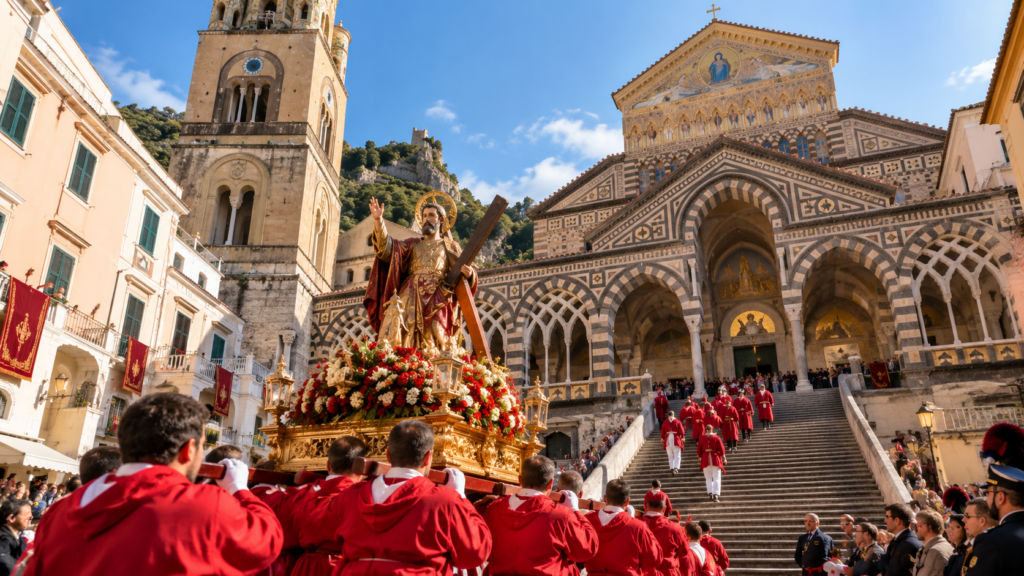
The celebration is known for its traditional procession through the streets of Amalfi and its spectacular finale: the bearers, dressed in red, run up the monumental staircase of Amalfi Cathedral carrying the statue of St. Andrew on their shoulders.
Unlike the busy summer months, late November offers visitors the opportunity to experience a more local side of Amalfi, when religious traditions and community life take centre stage.
The Procession of St. Andrew and the Famous Cathedral Staircase Run
The procession is the central event of the celebration.
The silver bust of St. Andrew is carried from the Cathedral through the narrow streets of Amalfi, accompanied by the faithful and a marching band. The traditional route also reaches the seafront, reflecting the town’s historic relationship with the sea.
The most eagerly awaited moment comes at the end of the procession.
As the statue returns to the Cathedral, the bearers, wearing their traditional red clothing, run up the steep staircase leading to the church entrance.
The ascent is accompanied by music from Gioachino Rossini’s Mosè in Egitto (Moses in Egypt), while the crowd gathered in Piazza Duomo watches and applauds.
Known locally as the Corsa del Santo, or Run of the Saint, this ritual is one of Amalfi’s most distinctive traditions.
For local people, it is much more than a public spectacle. It expresses the strong connection between the town, its religious heritage and its patron saint.
Why Does Amalfi Celebrate St. Andrew Twice a Year?
St. Andrew is celebrated in Amalfi on two dates: June 27 and November 30.
November 30 is the official feast day of St. Andrew in the Christian liturgical calendar. The June celebration, however, commemorates an event associated with Amalfi’s history.
According to local tradition, on June 27, 1544, the town was threatened by the fleet of the Ottoman admiral and corsair Hayreddin Barbarossa. A sudden violent storm prevented the attack, and the inhabitants attributed their deliverance to the protection of St. Andrew.
The two celebrations share important rituals but offer different experiences.
The June feast takes place during the summer tourist season, while the November celebration generally has a more intimate atmosphere, closely connected to the town’s religious and community life.
St. Andrew and Amalfi Cathedral: Eight Centuries of History
The devotion to St. Andrew has deep historical roots in Amalfi.
The Apostle’s relics were brought to the town from Constantinople in 1208 by Cardinal Pietro Capuano, following the Fourth Crusade.
They are still preserved in the crypt beneath Amalfi Cathedral, which remains an important place of pilgrimage and worship.
Another tradition associated with the saint is the so-called Miracle of the Manna.
According to local religious tradition, an oily liquid sometimes appears near the Apostle’s tomb. This phenomenon has been documented in the town’s devotional history for centuries and is regarded by believers as a sign of the saint’s protection.
Visitors interested in the history of Amalfi can explore the Cathedral complex, including its crypt, the Basilica of the Crucifix and the Cloister of Paradise.
St. Andrew’s Feast 2026: November 30 Programme
The next celebration takes place on Monday, November 30, 2026.
Cardinal Matteo Zuppi, Archbishop of Bologna and President of the Italian Episcopal Conference, is expected to preside over the solemn celebrations at the invitation of Archbishop Orazio Soricelli.
The detailed programme, including Mass times, the procession schedule and any additional events, has not yet been fully announced.
We will update this page as soon as the official programme becomes available, providing confirmed times and practical information for visitors wishing to attend the celebrations.
How to Attend St. Andrew’s Feast in Amalfi
The celebrations take place in Amalfi’s historic centre, with the Cathedral and Piazza Duomo as their main focal points.
The Cathedral is within walking distance of the town’s waterfront, bus terminal and harbour.
If you wish to watch the traditional staircase run, Piazza Duomo is the main viewing area. Arriving early is advisable, as the square can become very crowded during the final part of the procession.
Visitors should also consider the following practical information:
Date: November 30 every year.
Location: Amalfi Cathedral, Piazza Duomo and the historic centre.
Access: The religious procession takes place in public spaces and can be watched without a ticket.
Transport: Amalfi can be reached by SITA bus from Salerno and other towns along the Amalfi Coast. Check seasonal timetables before travelling.
Parking: Spaces are limited in the town centre, and temporary traffic restrictions may apply during the celebrations.
Weather: Late November can bring rain and cooler temperatures. Wear comfortable shoes and check the forecast before your visit.
Is St. Andrew’s Feast Worth Visiting Amalfi For?
For travellers interested in Italian traditions, local history and religious heritage, St. Andrew’s Feast offers an experience that is very different from a typical summer visit to the Amalfi Coast.
The procession and Cathedral staircase run provide an opportunity to witness a tradition that remains deeply meaningful to the local community.
It is particularly suitable for visitors already staying in Amalfi or nearby towns, and for those planning a cultural trip outside the main tourist season.
If you are visiting specifically for the celebration, remember that the procession follows a religious schedule rather than a tourist timetable. The precise timing should always be checked once the official programme is published.